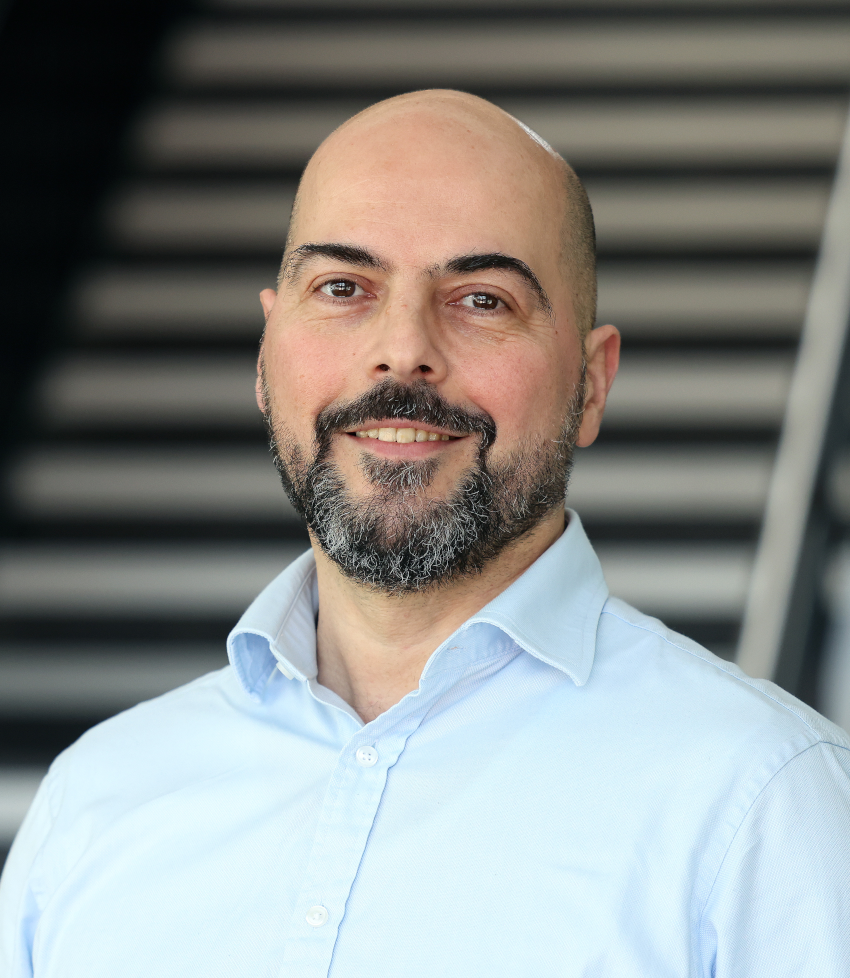







Welcome — and thank you for visiting.
I am a Neutrino Physicist and Professor of Experimental Particle Physics at the University of Liverpool, where I explore some of the universe’s most profound questions through the elusive neutrino.
My research focuses on precision measurements of neutrino oscillations, determinining the neutrino mass ordering, searching for CP violation in the leptonic sector, and hunting for signs of right-handed neutrinos. These investigation aim to explore the origin of matter-antimatter asymmetry of the universe, and probe the mechamism behind neutrino mass generation.
I’m always open to collaborations and conversations — feel free to explore the site or get in touch.
I am a Neutrino Physicist and Professor of Experimental Particle Physics at the University of Liverpool, where I explore some of the universe’s most profound questions through the elusive neutrino.
My research focuses on precision measurements of neutrino oscillations, determinining the neutrino mass ordering, searching for CP violation in the leptonic sector, and hunting for signs of right-handed neutrinos. These investigation aim to explore the origin of matter-antimatter asymmetry of the universe, and probe the mechamism behind neutrino mass generation.
I’m always open to collaborations and conversations — feel free to explore the site or get in touch.
More details on my current and past research activities
can be found here.
Currently, I am mainly active on the following projects:
 I am the Liverpool PI for the
Jiangmen Underground Neutrino Observatory (JUNO).
This is a major neutrino experiment in South China, near Hong Kong and Guangzhou,
using the world’s largest liquid scintillator detector.
JUNO will study reactor, atmospheric, solar, and geo-neutrinos, and perform searches for new physics beyond the Standard Model.
My research focuses on ML-based
event reconstruction, physics simulations, atmospheric neutrino studies and dark sector searches.
➢
JUNO at Liverpool
I am the Liverpool PI for the
Jiangmen Underground Neutrino Observatory (JUNO).
This is a major neutrino experiment in South China, near Hong Kong and Guangzhou,
using the world’s largest liquid scintillator detector.
JUNO will study reactor, atmospheric, solar, and geo-neutrinos, and perform searches for new physics beyond the Standard Model.
My research focuses on ML-based
event reconstruction, physics simulations, atmospheric neutrino studies and dark sector searches.
➢
JUNO at Liverpool
 I am centrally involved in preparations for the physics exploitation of the
Fermilab Short-Baseline Neutrino (SBN) Programme,
in particular in the
SBN Near Detector (SBND).
I am the Liverpool PI for SBN and SBND,
and I served as
a member of the SBND Executive Committee (2020-23),
SBND Physics co-Coordinator (2017-23), and
co-Coordinator of the SBN Systematics & Oscillation Sensitivity WG (2018-22)
My research is focussed on exploiting SBND data to characterize
neutrino-Argon cross sections and on new physics searches.
➢
SBND at Liverpool
I am centrally involved in preparations for the physics exploitation of the
Fermilab Short-Baseline Neutrino (SBN) Programme,
in particular in the
SBN Near Detector (SBND).
I am the Liverpool PI for SBN and SBND,
and I served as
a member of the SBND Executive Committee (2020-23),
SBND Physics co-Coordinator (2017-23), and
co-Coordinator of the SBN Systematics & Oscillation Sensitivity WG (2018-22)
My research is focussed on exploiting SBND data to characterize
neutrino-Argon cross sections and on new physics searches.
➢
SBND at Liverpool
 I am co-spokesperson of the international GENIE collaboration,
and one of the main authors of the well-known
GENIE event generator,
as well as of the corresponding
global analysis of neutrino scattering data informing GENIE tunes.
GENIE performs influential phenomenology research in the boundary between nuclear
and particle physics, provides a bridge between theory and measurement,
and it is a key ingredient in the exploitation effort of many experiments.
I am co-spokesperson of the international GENIE collaboration,
and one of the main authors of the well-known
GENIE event generator,
as well as of the corresponding
global analysis of neutrino scattering data informing GENIE tunes.
GENIE performs influential phenomenology research in the boundary between nuclear
and particle physics, provides a bridge between theory and measurement,
and it is a key ingredient in the exploitation effort of many experiments.
 I am one of the main authors and coordinator of
VALOR fitting group,
that develops the VALOR Software Development Kit (SDK) and
takes a lead role in the analysis of data from several neutrino experiments.
VALOR sprung from T2K where
the VALOR group produced over 20 reviewed oscillation physics analyses
and it has contributed to 12 published T2K papers, culminating in the
2020 Nature paper
on T2K neutrino CP violation constraints.
Currently, the group is mostly active on SBN/SBND and JUNO.
I am one of the main authors and coordinator of
VALOR fitting group,
that develops the VALOR Software Development Kit (SDK) and
takes a lead role in the analysis of data from several neutrino experiments.
VALOR sprung from T2K where
the VALOR group produced over 20 reviewed oscillation physics analyses
and it has contributed to 12 published T2K papers, culminating in the
2020 Nature paper
on T2K neutrino CP violation constraints.
Currently, the group is mostly active on SBN/SBND and JUNO.
 I have a keen interest in Quantum Information Science,
particularly its potential to transform computational approaches in fundamental physics.
Together with with researchers from the
Fermilab Quantum Institute and PhD students at Liverpool,
I'm involved in an exciting project to advance the frontier of quantum simulations for particle physics,
with a focus on nuclear effective field theories (EFTs) relevant to neutrino interactions.
We explore fault-tolerant quantum algorithms for simulating nuclear dynamics, from ground-state preparation to observable extraction.
By comparing qubit-based and hybrid oscillator–qubit platforms, we aim to reduce the resource overhead of simulating pion dynamics,
opening new possibilities for tackling classically intractable problems in neutrino-nucleus scattering.
I have a keen interest in Quantum Information Science,
particularly its potential to transform computational approaches in fundamental physics.
Together with with researchers from the
Fermilab Quantum Institute and PhD students at Liverpool,
I'm involved in an exciting project to advance the frontier of quantum simulations for particle physics,
with a focus on nuclear effective field theories (EFTs) relevant to neutrino interactions.
We explore fault-tolerant quantum algorithms for simulating nuclear dynamics, from ground-state preparation to observable extraction.
By comparing qubit-based and hybrid oscillator–qubit platforms, we aim to reduce the resource overhead of simulating pion dynamics,
opening new possibilities for tackling classically intractable problems in neutrino-nucleus scattering.
I am the Liverpool PI for the
Jiangmen Underground Neutrino Observatory (JUNO).
This is a major neutrino experiment in South China, near Hong Kong and Guangzhou,
using the world’s largest liquid scintillator detector.
JUNO will study reactor, atmospheric, solar, and geo-neutrinos, and perform searches for new physics beyond the Standard Model.
My research focuses on ML-based
event reconstruction, physics simulations, atmospheric neutrino studies and dark sector searches.
➢
JUNO at Liverpool
I am centrally involved in preparations for the physics exploitation of the
Fermilab Short-Baseline Neutrino (SBN) Programme,
in particular in the
SBN Near Detector (SBND).
I am the Liverpool PI for SBN and SBND,
and I served as
a member of the SBND Executive Committee (2020-23),
SBND Physics co-Coordinator (2017-23), and
co-Coordinator of the SBN Systematics & Oscillation Sensitivity WG (2018-22)
My research is focussed on exploiting SBND data to characterize
neutrino-Argon cross sections and on new physics searches.
➢
SBND at Liverpool
I am co-spokesperson of the international GENIE collaboration,
and one of the main authors of the well-known
GENIE event generator,
as well as of the corresponding
global analysis of neutrino scattering data informing GENIE tunes.
GENIE performs influential phenomenology research in the boundary between nuclear
and particle physics, provides a bridge between theory and measurement,
and it is a key ingredient in the exploitation effort of many experiments.
I am one of the main authors and coordinator of
VALOR fitting group,
that develops the VALOR Software Development Kit (SDK) and
takes a lead role in the analysis of data from several neutrino experiments.
VALOR sprung from T2K where
the VALOR group produced over 20 reviewed oscillation physics analyses
and it has contributed to 12 published T2K papers, culminating in the
2020 Nature paper
on T2K neutrino CP violation constraints.
Currently, the group is mostly active on SBN/SBND and JUNO.
I have a keen interest in Quantum Information Science,
particularly its potential to transform computational approaches in fundamental physics.
Together with with researchers from the
Fermilab Quantum Institute and PhD students at Liverpool,
I'm involved in an exciting project to advance the frontier of quantum simulations for particle physics,
with a focus on nuclear effective field theories (EFTs) relevant to neutrino interactions.
We explore fault-tolerant quantum algorithms for simulating nuclear dynamics, from ground-state preparation to observable extraction.
By comparing qubit-based and hybrid oscillator–qubit platforms, we aim to reduce the resource overhead of simulating pion dynamics,
opening new possibilities for tackling classically intractable problems in neutrino-nucleus scattering.